




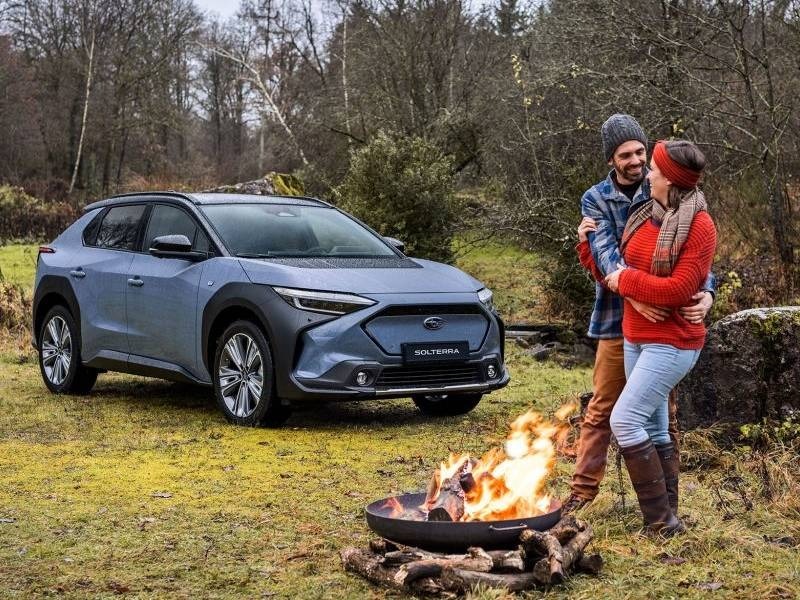
Is the Subaru Solterra Worth Buying? Pros, Cons & Honest Verdict
The Subaru Solterra is a capable electric SUV with standard all-wheel drive, useful off-road features and a well-equipped interior. However, its relatively high purchase price, modest range compared with some rivals and cold-weather efficiency deserve careful consideration. So, is it worth buying?
The answer depends on what you want from an electric car. If you value all-weather traction, everyday comfort and the confidence to tackle muddy tracks or slippery country roads, the Solterra makes a compelling case. If your priorities are maximum driving range, the lowest possible running costs or the best value for money, there are alternatives worth investigating.
In this review, we examine the Subaru Solterra's advantages, disadvantages, performance, practicality, charging capabilities, ownership costs and alternatives to help you decide whether it deserves a place on your shortlist.
What Is the Subaru Solterra?
The Subaru Solterra is the Japanese manufacturer's first mass-market all-electric SUV. It was developed in collaboration with Toyota and shares its underlying electric vehicle platform with the Toyota bZ4X.
Although the two vehicles have much in common, the Solterra follows Subaru's traditional emphasis on all-wheel drive, outdoor capability and confidence on challenging surfaces.
The name combines the Latin words for sun and earth, reflecting the model's electric powertrain and adventure-oriented positioning.
For the existing UK-market version, the key specifications are:
-
Battery: 71.4kWh lithium-ion battery.
-
Powertrain: Dual electric motors with permanent all-wheel drive.
-
Maximum power: 218PS.
-
Maximum torque: 336Nm.
-
Official WLTP range: Up to 289 miles in Limited trim.
-
Official WLTP range in Touring trim: Up to 257 miles.
-
Maximum DC rapid-charging power: 150kW.
-
Acceleration: 0–62mph in 6.9 seconds.
-
Ground clearance: 210mm.
-
Starting on-the-road price: £52,505 at the time reflected by Subaru UK's published specification.
These figures are based on Subaru UK's official Solterra specifications and pricing. They should not be applied automatically to the updated 2026 model, which has different announced specifications.
The Solterra competes in the electric family SUV market, where buyers can also consider the Tesla Model Y, Skoda Enyaq, Kia EV6, Hyundai Ioniq 5 and Toyota bZ4X.
Its biggest selling point is straightforward: unlike many electric SUVs, it makes all-wheel drive standard rather than reserving it for selected higher-powered versions.
Subaru Solterra Pros and Cons at a Glance
The pros
-
Standard dual-motor all-wheel drive.
-
Strong traction on wet, slippery and loose surfaces.
-
210mm of ground clearance.
-
Smooth, quiet electric performance.
-
Useful standard equipment, including a heat pump.
-
Apple CarPlay and Android Auto integration.
-
Comfortable cabin with practical family-car features.
-
No tailpipe emissions while driving.
The cons
-
High starting price compared with several electric SUV alternatives.
-
Limited's 289-mile WLTP range is not class-leading.
-
Touring's larger wheels reduce its official range to 257 miles.
-
Cold weather and motorway speeds can significantly reduce real-world range.
-
Boot space and luggage flexibility are less impressive than some rivals.
-
Three-year, 60,000-mile standard manufacturer warranty.
-
Depreciation and insurance costs deserve careful consideration.
The balance between these strengths and weaknesses explains why the Solterra is a more convincing choice for some drivers than others.
1. Performance and Driving Experience
One of the Solterra's strongest attributes is its smooth, predictable electric performance.
The existing UK model uses two electric motors, one on each axle. Together, they produce 218PS and 336Nm of torque, providing enough performance for everyday driving, overtaking and joining fast-moving traffic.
Its official 0–62mph acceleration time of 6.9 seconds is respectable for a family SUV. It will not match the quickest performance-focused electric cars, but instant electric torque makes it feel responsive when pulling away from junctions or accelerating through urban traffic.
Another advantage is refinement. Without a conventional petrol or diesel engine, the Solterra delivers quiet, uninterrupted acceleration. This makes it particularly appealing for commuting, school runs and longer journeys.
However, buyers should not mistake its smooth power delivery for a sporty driving experience. The Solterra is primarily designed to be reassuring and composed rather than thrilling.
Its steering, suspension and overall handling suit drivers who want a comfortable, predictable SUV. The vehicle's substantial battery contributes to a low centre of gravity, helping it feel planted through corners.
Verdict on performance: The existing Solterra is quick enough for most family drivers and feels refined in everyday use. Its performance is competitive rather than exceptional.
2. All-Wheel Drive and Off-Road Capability
This is arguably the Solterra's biggest advantage over many mainstream electric SUVs.
Both electric motors work together to deliver power to the front and rear wheels. The system can adjust torque distribution according to driving conditions, helping the vehicle maintain traction when surfaces become slippery or uneven.
Subaru also equips the Solterra with X-MODE and hill descent control. These systems are designed to improve control on challenging surfaces, including snow, mud and loose ground.
Ground clearance is another important factor. At 210mm, the existing Solterra offers useful clearance for an electric family SUV. That can be beneficial on rough rural lanes, uneven access roads, muddy campsites and tracks that would make a conventional low-slung car less suitable.
For drivers living in rural parts of the UK, these features can be more valuable than an extra 30 or 40 miles of advertised range.
However, there are limits. The Solterra is not a dedicated off-roader, and all-wheel drive does not eliminate the importance of tyres, driving technique or ground conditions. It should not be treated as a substitute for a purpose-built four-wheel-drive vehicle on extreme terrain.
It is also important to distinguish all-wheel drive from winter-proofing. The system helps the car put its power down, but stopping distances on snow and ice still depend heavily on tyre grip and road conditions.
Verdict on capability: If you regularly drive on slippery roads, gravel, muddy tracks or rural routes, the Solterra's standard all-wheel drive and ground clearance are meaningful benefits.
3. Driving Range: Is It Enough?
Range is one of the most important considerations when buying an electric SUV.
Subaru quotes up to 289 miles under the WLTP combined testing procedure for the existing Solterra Limited. The Touring model has a lower official figure of 257 miles, largely reflecting its larger 20-inch wheels.
WLTP figures provide a useful comparison between vehicles, but they are not a guarantee of the distance you will cover in everyday driving.
Actual range depends on several factors, including:
-
Driving speed, particularly sustained motorway speeds.
-
Outside temperature and battery temperature.
-
Heating and air-conditioning use.
-
Tyre pressures and wheel specification.
-
Passenger numbers and luggage load.
-
Terrain, traffic and driving style.
Cold weather is particularly relevant in the UK. Battery performance and cabin heating requirements can reduce efficiency during winter, while sustained motorway driving can consume energy faster than mixed-speed journeys.
Consequently, drivers planning regular long-distance journeys should avoid assuming that a fully charged Limited will consistently cover 289 miles.
A more sensible buying approach is to consider your typical journey lengths and leave a margin for weather, detours and charging availability. If you frequently drive several hundred motorway miles in a day, a longer-range alternative may be more convenient.
The Touring model also deserves particular scrutiny. Its additional equipment and larger wheels may appeal, but its 257-mile official range is a considerable reduction compared with the Limited.
The updated Solterra announced by Subaru promises a longer range, but its headline figures should not be compared directly with the existing model without checking the applicable testing standard, UK specification and final published figures.
Verdict on range: The existing Solterra should suit daily commuting, family journeys and many longer trips. However, buyers who regularly undertake long motorway journeys may prefer an electric SUV with greater range and efficiency.
4. Charging Speed and Convenience
Charging convenience can make a significant difference to electric-car ownership, particularly if you regularly travel long distances.
The existing UK-market Solterra supports AC charging at up to 7kW and DC rapid charging at up to 150kW.
Subaru quotes approximately 30 minutes to charge from 20% to 80% using a suitable 150kW DC charging point. This is a manufacturer's indicative figure, not a guarantee for every charging session.
Actual charging speed depends on battery temperature, the charger's available output, the battery's state of charge and other conditions. Charging also generally slows as the battery approaches full capacity.
For longer journeys, charging from 20% to 80% is often more practical than waiting for a complete recharge.
At home, a compatible dedicated wallbox can make everyday charging much more convenient. A 7kW connection is well suited to overnight charging, although the time needed depends on how much energy the battery requires.
Drivers without off-street parking face a different calculation. Depending on their location, they may need to rely on public AC chargers, rapid chargers or workplace charging. Public charging prices can also make a significant difference to running costs.
The announced 2026 Solterra update includes charging improvements and battery preconditioning, which is intended to help prepare the battery for rapid charging in appropriate conditions. Buyers should confirm the precise UK specification before paying a deposit.
Verdict on charging: The existing Solterra offers competitive rapid-charging capability on paper, and home charging makes it easy to live with.
5. Interior Quality, Comfort and Technology
The Solterra's cabin is functional, modern and designed around everyday usability.
The existing UK model features a 12.3-inch central touchscreen, Apple CarPlay and Android Auto integration, along with a digital instrument display. These features provide access to navigation, entertainment, smartphone applications and essential vehicle information.
The layout prioritises practicality rather than luxury-car extravagance. Buyers should expect a well-equipped mainstream electric SUV, not necessarily the premium materials or sophisticated cabin ambience of a more expensive luxury model.
The driving position deserves a personal test drive. Some reviewers have questioned its ergonomics, so drivers should check that the steering wheel, instrument display and seat position work comfortably together.
Front-seat comfort, visibility and access to the controls are especially important if you spend several hours a day behind the wheel.
The Solterra also includes useful everyday equipment. Depending on trim, features include heated seats, dual-zone climate control, a powered tailgate and a 360-degree panoramic camera system.
The standard heat pump is another positive feature. It can improve the efficiency of cabin heating compared with less efficient heating approaches, although it cannot prevent winter range loss altogether.
Subaru has announced a redesigned interior and a larger 14-inch touchscreen for the updated Solterra. These improvements may make the newer model more appealing to technology-focused buyers.
Verdict on the interior: The existing Solterra is sensibly equipped and comfortable for everyday use.
6. Practicality and Family Use
As a medium-sized SUV, the Solterra offers a useful blend of passenger space, elevated seating and family-friendly convenience.
Its five-seat layout makes it suitable for many households, while the rear seats can accommodate passengers who need more space than a typical hatchback provides.
Nevertheless, buyers should assess the vehicle's luggage capacity carefully.
The existing Solterra's boot is less generous than that of some key competitors, including the Tesla Model Y and Skoda Enyaq, according to independent reviews. This could matter if you regularly carry pushchairs, bulky sports equipment, holiday luggage or a family's worth of shopping.
There is also no additional front luggage compartment to provide extra storage.
For everyday commuting and moderate family use, this may not be a serious drawback. For larger families or drivers who regularly transport bulky items, it could become frustrating.
Before purchasing, take your usual luggage to a dealership and check how it fits. If you regularly travel with child seats, test their installation and make sure rear-seat access remains comfortable.
Consider roof-box compatibility and any associated range implications if you often carry more luggage than the standard boot can accommodate.
Verdict on practicality: The Solterra works well as a general family SUV, but it is not the strongest choice for buyers who need maximum boot space.
7. Running Costs, Reliability and Warranty
One of the attractions of an electric vehicle is the potential to reduce day-to-day running costs.
Electric cars generally require less routine powertrain maintenance than petrol or diesel vehicles because they have fewer conventional engine components. There is no engine oil to replace, for example, and regenerative braking can reduce friction-brake wear in suitable driving conditions.
However, electric cars are not maintenance-free. Tyres, brakes, suspension components, cabin filters and other items still require inspection and servicing.
How much does it cost to charge?
The answer depends on your electricity tariff, charging losses and driving efficiency.
A useful estimate is:
Cost per mile = electricity price per kWh × electricity consumed per mile.
For example, if a car averages 3 miles per kWh and your electricity costs 25p per kWh, the energy cost is approximately 8.3p per mile.
That is an illustration, not a claim about the Solterra's guaranteed efficiency or the electricity tariff available to you. Public rapid charging can cost considerably more than charging at home on a suitable tariff.
You should also budget for insurance, tyres, servicing, depreciation and vehicle tax. Electric vehicles are no longer universally exempt from UK vehicle excise duty, so check the applicable rules and rates for the vehicle and registration year.
Is the Solterra reliable?
The Solterra benefits from Subaru's engineering involvement and shares substantial underlying technology with the Toyota bZ4X. That relationship is relevant when assessing its design and mechanical architecture.
However, shared components do not prove that every example will be trouble-free. Reliability depends on the individual vehicle, maintenance, software and the way it has been used.
Before buying a used Solterra, check its service history, recall completion, software updates, battery condition and remaining warranty. A qualified inspection is worthwhile if the car's history is incomplete.
What warranty does it have?
Subaru UK's published warranty information lists:
-
A three-year or 60,000-mile manufacturer warranty, whichever comes first.
-
An eight-year or 100,000-mile battery warranty, whichever comes first.
-
A 12-year anti-corrosion warranty for bodywork.
-
A three-year or 60,000-mile paintwork warranty.
-
Three years of recovery and assistance cover in the UK and Europe.
Read Subaru's official Solterra warranty information for the relevant terms and exclusions.
The battery warranty should not be interpreted as a promise that the battery will retain its original capacity throughout that period. Buyers should examine the actual coverage conditions.
Verdict on ownership costs: Home charging can make the Solterra economical to run, but insurance, depreciation and purchase price may offset some of the savings. Check the full ownership cost rather than judging the car by electricity expenses alone.
8. Should You Buy the Existing Solterra or Wait for the Updated Model?
This is an important question for anyone shopping for a new Solterra in 2026.
Subaru has announced a substantial update featuring a larger 73.1kWh battery, up to 316 miles of manufacturer-estimated range, more powerful dual-motor performance and improved charging. The manufacturer also advertises towing capacity of up to 1,500kg for the updated model.
These are announced specifications, not figures that should automatically be assumed for every UK-market vehicle. The official UK page should be checked for final specifications, prices, delivery timing and equipment.
The changes address several of the existing Solterra's main weaknesses, particularly range and performance.
If you are buying new, compare the outgoing car's actual dealer offer with the updated model's confirmed UK price. A substantial discount on the existing model may make it attractive, especially if your driving needs are modest.
On the other hand, paying close to the original list price for an outgoing model becomes harder to justify when a substantially improved version is available or imminent.
For used-car buyers, the existing Solterra may represent better value because depreciation can reduce its purchase price. That does not guarantee a bargain, however: battery condition, remaining warranty, mileage and service history all matter.
The sensible approach is to compare the exact vehicles available to you rather than making a decision based solely on model-year labels.
Final Verdict: Is the Subaru Solterra Worth Buying?
Yes, the Subaru Solterra is worth considering.
The existing model makes sense for drivers who genuinely benefit from standard all-wheel drive, live in rural areas or regularly encounter slippery roads and uneven tracks. It offers smooth electric performance, useful safety and convenience equipment, a heat pump and a reassuringly capable chassis.
It is also a reasonable choice for households that can charge at home and whose daily journeys fit comfortably within its real-world range.
The updated 2026 Solterra is particularly relevant because Subaru has announced improvements to range, power and charging. So, anyone buying new should establish which version is actually available and whether the price difference justifies choosing the outgoing car.
For used buyers, a well-maintained example at a substantial discount may be more appealing than a new car at its original list price.
Who should buy the Subaru Solterra?
-
Drivers who value standard all-wheel drive.
-
Rural households that encounter mud, snow or rough access roads.
-
Buyers who appreciate a comfortable, quiet electric SUV.
-
Owners who can charge conveniently at home.
-
Used-car shoppers who find a well-maintained example at an attractive price.
Our recommendation: Test-drive the Solterra, compare its total ownership cost against at least two competing electric SUVs, and check the updated model's confirmed UK specifications before committing. If you value Subaru's approach to traction and all-weather capability, it could be the right electric SUV for you.
Ultimately, the Subaru Solterra is a capable and distinctive electric SUV whose appeal depends on whether its strengths match your driving needs. Buy it for its all-wheel-drive capability and everyday usability, not simply because it is an electric SUV with a familiar badge.